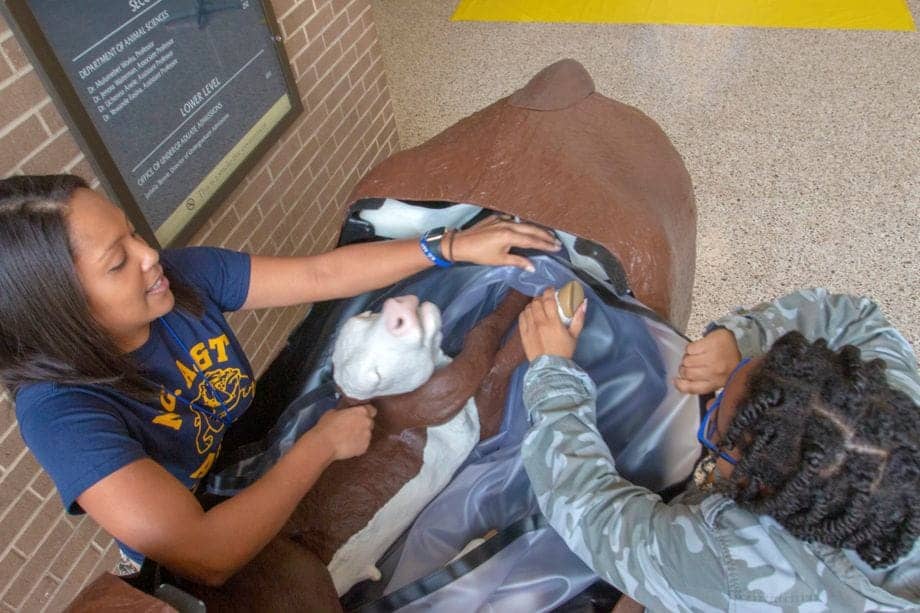
Andrea Gentry-Apple, a professor in the Department of Animal Sciences, positions the 80-lb. calf inside Webb Hall’s new veterinary model cow as Kylie Simpson, a senior animal science major from Greensboro, assists.
Beatrice the cow moved into Webb Hall this past October.
Around the same time, the CAES’s Department of Animal Sciences also welcomed a horse into the building.
Right away, animal sciences students started pushing, pulling, milking and practicing injections on the animals – but they didn’t mind. In fact, the animals were pretty quiet the entire time.
The two life-size, functional animals are veterinary models, custom-made for the CAES. The models will help Andrea Gentry-Apple, D.V.M., and the department’s other professors teach students how to approach real-world situations while still in the classroom.
“The models help us teach situational scenarios in a safe environment,” Gentry said. “The students can learn how it feels to work with a big animal, and get some practice, before they actually have to work with an animal that may be under stress that can kick, bolt or bite.”
Students of all years will have access to the animals, a key recruiting and retention factor, Gentry said.

Andrea Gentry-Apple, a professor in the Department of Animal Sciences, talks to Kylie Simpson about the capabilities of the model cow that the department recently received. Simpson, a senior animal science major from Greensboro, assisted Apple during the Annual CAES Alumni Homecoming Celebration and Cookout at B.C. Webb Hall Friday, October 25, 2019.
The life-size cow, complete with 80-lb. calf, has a fully-functioning udder and can demonstrate birthing procedures and internal calf “management” in addition to the more routine injections, eye and ear care, and artificial insemination.
The horse, which simulates a more-than-1,000 pound animal, can demonstrate haltering, injections, restraints, leg-wrapping and other routine skills, in addition to more complicated abdominal and reproductive issues.
Students can also learn how – and where – the animal is likely to move if it feels uncomfortable, and how to bring it back under control.
Kylie Simpson, a senior animal sciences major from Greensboro, is excited to have the animal models.
“I want to have the practice before I get to animals on the farm,” she said. “It helps build confidence if you didn’t grow up on a farm.”
The department unveiled the animals to alumni and friends during the Greatest Homecoming on Earth cookout in October.
“We wanted to let our alumni know how we’re giving our students an edge,” Gentry said. “We’re proud that we’ve grown to the point that we need to use teaching tools like this.”