Artificial intelligence increasingly plays a role in our lives. Mark Light, Ph.D., wants to ensure that North Carolina 4-H agents and youth have the opportunity to understand AI and put it to use as a tool for learning and discovery.
Light is the 4-H STEM (science, technology, engineering and math) specialist with N.C. A&T Cooperative Extension and the statewide lead of a new, two-year, $225,000 grant from Google, part of an overall $25 million Google initiative to develop AI literacy among educators and students, teaching them to use AI in the classroom and beyond.
The Google initiative targets 10 states and five youth organizations, including 4-H. Its overall goal is to equip more than a half-million educators and students across the U.S. with foundational AI skills through the development of AI curriculums, training and meaningful, inclusive AI learning experiences for youth audiences.
“You hear so much about AI and a lot of times we think of the negative,” said Light, “What we want to do is turn this dialogue around and look at AI from a positive standpoint, and say, ‘How can we use AI in everyday life to improve things and help ourselves?’ ”
The grant is hands-on, Light said. Rather than each state providing an AI curriculum, educators from the 10 states supported by the grant (Colorado, Florida, Indiana, Iowa, Nebraska, Ohio, North Carolina, South Carolina, Utah and Pennsylvania) have formed a National AI Curriculum Committee, co-chaired by Light, that will develop 4-H curriculums and best practices for using AI. Youth will be engaged as AI educators for adults and younger children in their communities, much like 4-H Tech Changemakers teach technical literacy skills to adults in their communities.
Some of the issues the curriculum committee will address include using and documenting the use of AI in 4-H project work, ensuring that all 4-H members have equal access to AI tools, AI in agriculture, and creating 4-H projects that give youth the chance to use AI.
“We want to establish best practices and show AI can be an extension of their Google searches,” said Light. “Nowadays we don’t think twice about typing a question into a Google search. Essentially, we are already using AI.”
By the time the grant concludes in May 2026, Light plans to have reached at least 15,000 North Carolina youth and 2,000 adults with AI education and training.
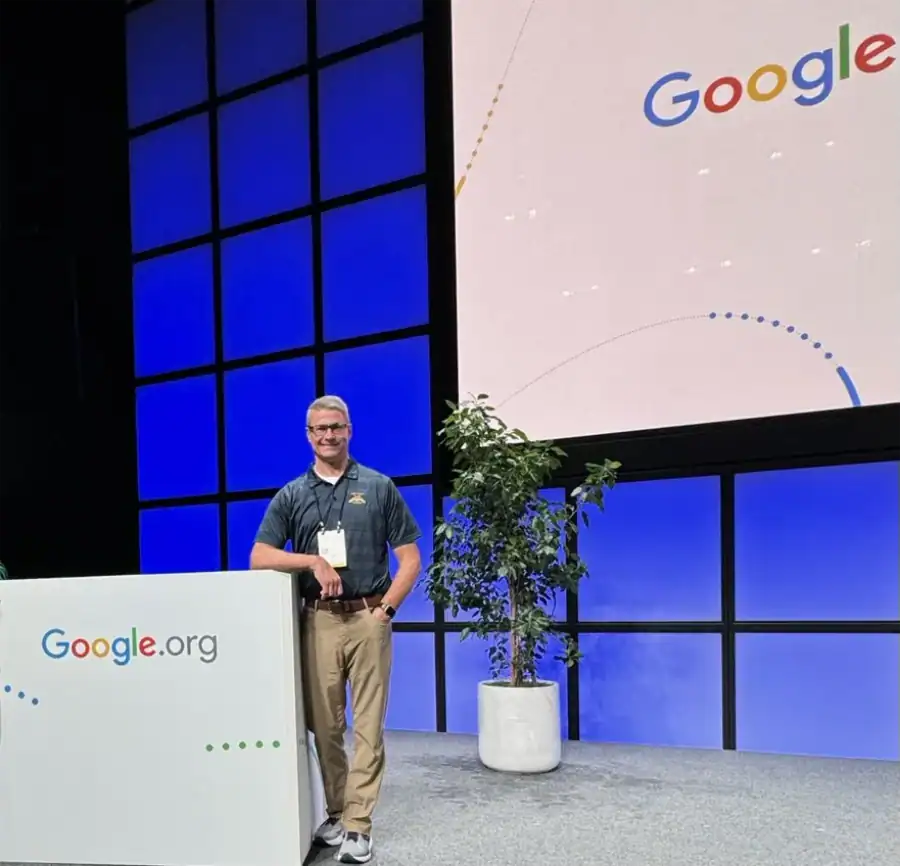
Light recently attended the first AI Impact Summit at Google Headquarters in Mountain View, CA, where he had the chance to learn more about AI and its uses from Google executives, app developers and educators who use AI in schools, community programs, and with non-English speaking and other underserved audiences.
“We want to come up with best practices about integrating AI into the current work that we're already doing with youth,” he said. “And even though there's 10 states involved in the initiative, what we develop could be shared with the other 40 states that are also probably struggling with this topic.”
Light and his peers in the nine other states plan to introduce the AI initiative to Extension staff this fall. They also plan to launch a nationwide AI Challenge for 4-H members next spring, using the prompt “How would you use AI to solve problems in your community?”
“We want to show how AI fits in with the topics 4-Hers already are involved in, such as agriculture,” said Light. “You don’t usually think big tech and Silicon Valley when you think agriculture, but there are all sorts of connections between AI and agriculture and a lot of career paths that combine tech and agriculture.”