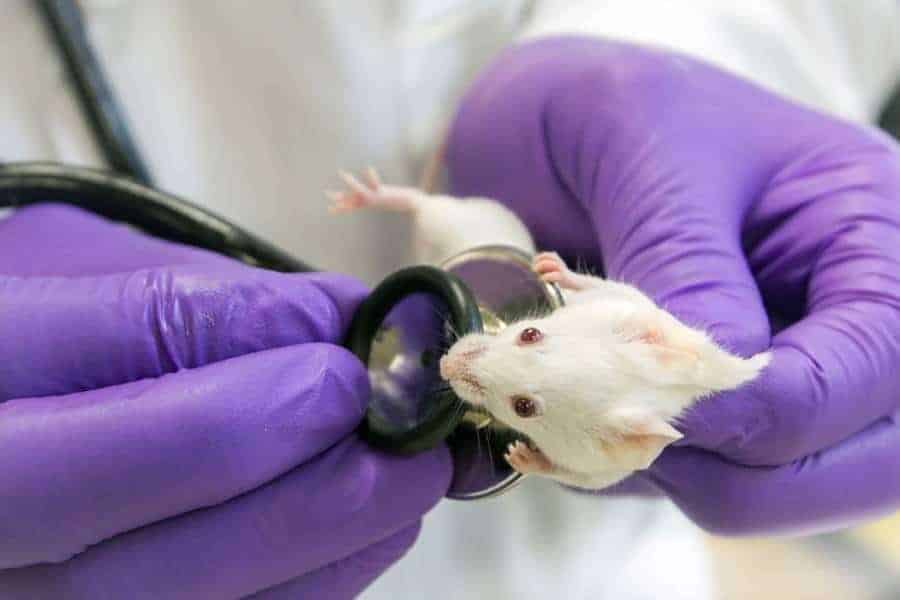
An Animal Sciences student checks a lab mouse's heart in class recently. The program has grown to the point that it may be the HBCU sending the largest number of minority students on to veterinary school.
Despite interruptions from COVID-prompted course changes, N.C. A&T’s animal sciences program continued to blossom this year. In fact, the program has grown to the point that it is one of the main HBCU programs placing minority students in veterinary schools across the country, according to Andrea Gentry-Apple, DVM.
“It’s hard to quantify, but based on our size as the largest animal sciences program among the HBCUs, we may be the program sending the most students on to vet school,” she said. “This past cycle, 12 of our undergraduate, graduate and recent graduate students were accepted to vet school, and 11 went. One decided to get a master’s first.”
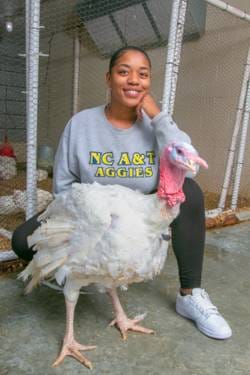
Access to animals is one of the CAES program's strengths, students say. Two new animal models were added over the summer, to teach animal CPR.
There are 34 veterinary schools at institutions across the country; many of A&T’s students stay close to home, attending N.C. State University. Others may attend another institution that could possibly also lay claim to having the most diverse students to enter the profession, Tuskegee University in Alabama.
The American Veterinary Medical Association launched an effort to diversify the profession in 2005, but the initiative has been slow to gain traction, Apple said. “My role is to try to give my students and our facility exposure so that people working in veterinary medicine can see what we have, and the kind of quality students we have.”
Finding diverse mentors for diverse students is part of the challenge, Apple said. When animal owners take their pets to the vet, or farmers call in a vet, that person is likely to be white, making it difficult for diverse animal owners to see themselves in the role.
“Even if it’s a great vet, a member of a minority community wouldn’t necessarily look at them and realize, ‘There’s someone who looks like me, and they’re doing this job so I can, too,’” Apple said.
To tackle the challenge of exposure, Apple started Pre-Vet Field Day, a two-day conference held in Webb Hall. Invited were other institutions, veterinarians and other industry professionals offered testimonials, resume-building advice, mock interviews and more to prepare the students for applying to hard-to-get seats in vet schools.

As recently as 2015, Apple said, the department could offer two animals to one student to practice care upon. This semester, that ratio is one animal for every three students.
“Things like that make a big difference in how much actual real-life care we can teach, and that type of learning gives our students an edge, so it’s very important that we maintain our edge,” she said.
Five schools came in 2019. This spring, more than 15 were set to attend, before COVID concerns sidelined the event. Still, Apple said that she’s pleased with the progress.
“It’s a long-term commitment, not one that we can solve in a semester,” she said. “We’re doing a lot of good things and our program is growing. I’d put my students up against any program, anywhere. They’re going to be that prepared.”