The 18 agricultural research stations supported by the N.C. Department of Agriculture and Consumer Services are growing a new generation of opportunities for farmers and growers through their research, according to Commissioner Steve Troxler.
If the key to feeding a hungry planet is agricultural production, the key to production is agricultural research.
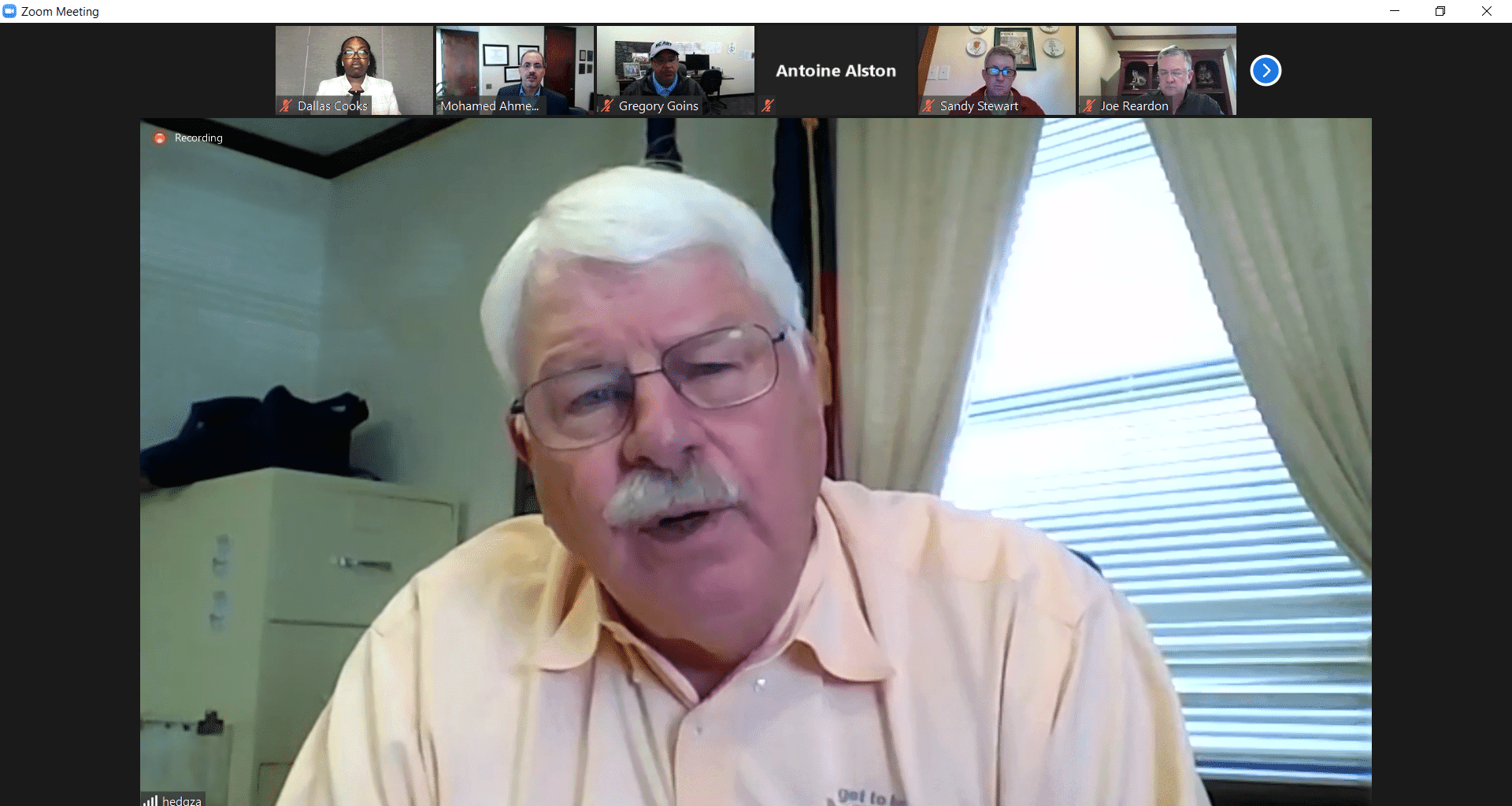
That was the message of N.C. Commissioner of Agriculture Steve Troxler and Teresa Lambert, division director of research stations, who visited campus virtually on Aug. 26 in the first of three forums planned this semester involving the NCDA&CS and the College of Agriculture and Environmental Sciences about issues in agriculture and policy. Students, faculty, Extension staff and other members of the CAES attended the first online discussion of the semester, with a question and answer mediated on Zoom by junior animal sciences major Tahira Jones, president of the college’s chapter of Minorities in Agriculture, Natural Resources and Related Sciences (MANRRS).
The second forum will be held on Zoom from 2-3 p.m. on Sept. 23 and will focus on the agency’s work with small farms. The third, set for 2 p.m. on Nov. 18, will discuss the importance of partnerships.
Agriculture’s economic impact is nearly $96 billion in North Carolina and growing, and much of its growth has been realized through research, conducted in part on the 18 research stations located throughout the state, Troxler said.
“It’s always too wet, too dry, too hot or too cold. The way to move beyond that is through research and use of innovative new technologies,” Troxler said.
“My grandmother grew up on a farm in the mountains, where everyone farmed with mules and planted by the moon signs. The year she was born, 1913, the national corn yield was 27 bushels per acre,” Lambert said. “The year she died, 2014, we were farming with GPS-driven tractors with auto-steer technology using satellites, using the latest technology in variable-rate fertilization, and the national corn yield that year was close to 500 bushels per acre. We came that far in one person’s lifetime, and that’s 100 percent attributable to research and innovation in agriculture. We want to continue that same trajectory moving forward because the world’s population is growing.”
Technological advances have also improved farming families’ lives by allowing for educational access, noted Greg Goins, chairperson of the Department of Natural Resources and Environmental Design.
“The kids can go to school because they don’t have to be on the farm as much, thanks to the increase in science. That has made a big difference for a lot of African American families,” Goins said.
N.C.’s research stations are strategically placed across the state to serve the growers of the state’s very diverse regions.
“We’re third in the nation in terms of diverse agricultural commodities, partly because of our great variation in soil types and topography, climate, and growing conditions,” Lambert said. “Researchers can actually find commodities that do well in each area by experimenting with them on these stations, and then, they can make recommendations to the growers in that area.”
Research on the same crop varieties is replicated across many stations in many different regions and multiple growing conditions, she said.
“A variety that does well in the Piedmont may not do as well in the coastal plain, but we would at least be able to get those hard, fast numbers so that we could make recommendations to farmers,” Lambert said. “We use numerous replications to account for our state’s diverse soil types.”
Some of the stations are also working with sub-surface drip irrigation technology, which will not only allow more water to stay near the plant’s roots, but will also allow nutrients to be dispersed to the plants more efficiently, she said.
Horticulture and livestock research are also functions of the stations. At the Piedmont research station in Salisbury, a “Fit Bit” -type transponder attached to a cow’s leg can track not only her steps, but the time she spends eating and ruminating, or lying down. The information is sent back to a computer so that ranchers can make decisions in the moment.
“If that cow has been sluggish that day, and has not walked the number of steps or done the amount of ruminating we’d expect, they know to sort her out and make sure everything is good with her before she becomes clinical,” Lambert explained.
Robotic calf feeding systems, using computer chips on tags in each calf’s ear, tell the computer what nutrition it needs and what its birth date and weight should be and are also among the technology sin study at the Piedmont station, Lambert said.
NCDA & CS’s research into calf- rearing systems and heifer development will set our state apart in advancing livestock research, Lambert said.
Educational outreach - showcasing the importance of agriculture to students and visitors - is another important function of the stations. So, too, are internships and other opportunities offered to students, including those from N.C. A&T, who have had internships in the past.
“We’ve had numerous A&T students work on our stations, and it’s a wonderful partnership,” Lambert said. “Research stations are so clever and innovative, and they’d love to have students.”