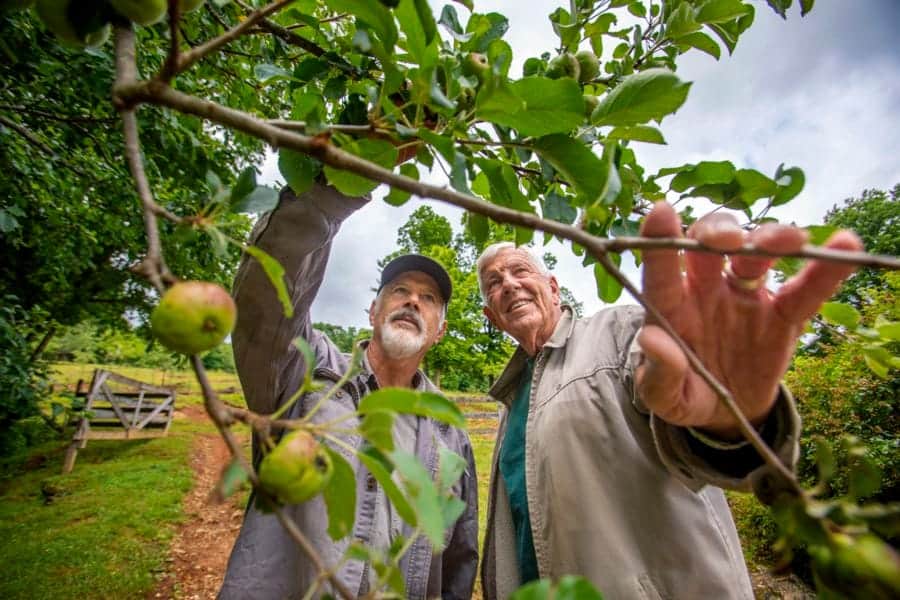
Extension Agent Bill Hoffman works with Avery County apple grower Chris Eswine on a protocol for controlling diseases on his trees. “The apples were about 30% bigger, and they were perfect,” said Eswine.
Commercial apple growers must constantly contend with pests and diseases as most larger growers spray their fruit trees with pesticides and fungicides as often as every 10 days.
That’s why Chris Eswine, a farmer in Avery County, turned to Cooperative Extension at N.C. A&T when he wanted to produce cleaner, more usable apples.
“I was getting lots of imperfections in the apples,” said Eswine, who retired from a career in banking about a decade ago and now grows apples and grapes and raises a few cattle on land owned by his 97-year-old mother-in-law. Eswine had worked with Doug Hundley, formerly an Extension Integrated Pest Management technician in Avery County, to graft apple trees and save the heirloom trees on the farm. This time, he turned to Avery County ANR Agent Bill Hoffman for help.
Together, Eswine and Hoffman focused on a 40-tree section of the orchard during the 2020 growing season. Hoffman did some research and came up with a plan to spray the trees three times: twice to control for disease, coddling moths, and other insects, and once to control for disease and apple maggots—the worms everyone hates to find when they bite into an apple.
“The results were astounding to say the least,” said Eswine. “The trees themselves looked much better. The apples were about 30% bigger, and they were perfect.”
Hoffman said large commercial apple growers with monoculture orchards need to spray often to keep their apples healthy. Small growers and hobbyists, which is typical for those in Avery County, can get by with fewer applications because they have smaller plots and often grow heirloom varieties that have some natural disease resistance.
“In Extension, we can get down to the individual level and work one-on-one,” said Hoffman. “I’ll do a workshop or a meeting, and attendees will come to me and tell me about their problems. Yes, we do field visits and demonstration plots. That’s what Extension has been doing for years.”
Eswine has about 180 apple trees growing heirloom varieties and cider apples in three plots. The demonstration plot he established with Hoffman is comprised mostly of heirloom varieties, including Winesap, Macintosh, Virginia Beauty, and Sheepnose. When Hoffman communicated the results of Eswine’s minimal spray program in an email to local farmers, two more growers expressed interest in the program. Others asked if the same spraying schedule would work with organic insecticides and fungicides.
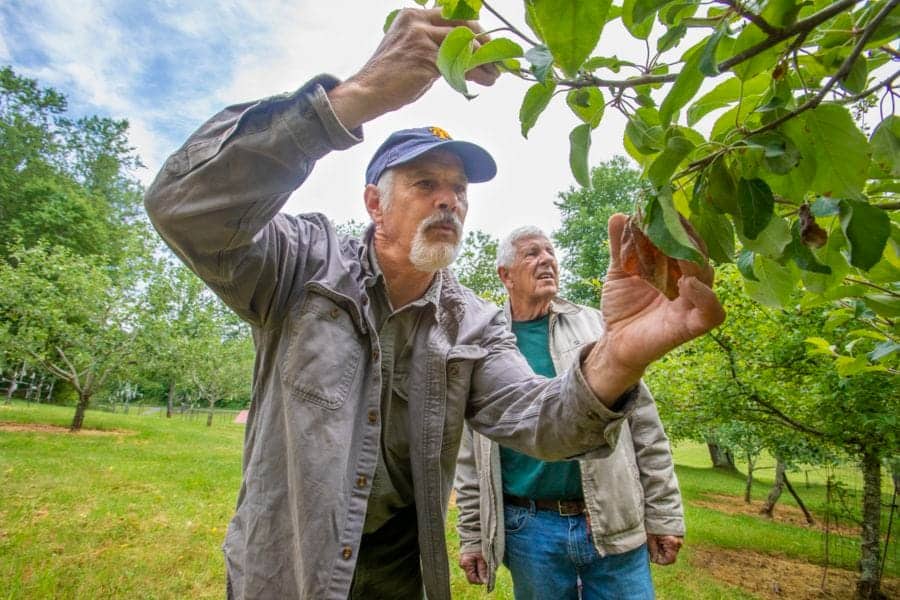
Hoffman checks a tree in Eswine’s orchard for blight.
As a result, Hoffman has launched a demonstration plot that uses a kaolin clay spray to control insects. The clay coats the trees in a thin white film that acts as a barrier and repels insect pests from landing on the leaves of the trees. Kaolin clay is a highly refined clay, and Hoffman said many organic pest control products, including those made from sulfur and copper, come from minerals and bacterium found in soil.
“They don’t have the persistency of synthetic products, so you have to spray more frequently,” he said. “For small plots of fruit, especially the heirloom varieties with some natural resistance, they can be very effective.”
Avery County is not the apple capital of North Carolina—that title belongs to Henderson County. However, several farmers have taken up an “Avery Apple Project,” first launched by Hundley, which aims to bring back the area’s heirloom varieties.
Some of these heirloom varieties are exceptionally rare. For example, Eswine had several very old apple trees on his farm and couldn’t identify one of the trees. Hundley recognized it as a Junaluska, a tree rarely found in modern times named after Cherokee Chief Junaluska, an ancestor of the modern-day Eastern Band of Cherokee Indians. The chief, according to Eswine, wouldn’t sell a parcel of his land to the government because of his prized apple tree that grew there. This particular tree was planted by Walter Ledford, the father of Eswine’s mother-in-law, in about 1915.
“A lot of the growers I work with are growing old-time varieties,” said Hoffman. “Red delicious, golden delicious, these are heirloom apples, and some varieties were discovered as seedlings and grafted onto a rootstock.”
As for Eswine, he currently falls into the category of hobbyist apple grower, who gives away bushels of apples to his brother, the head of science education in a school in Savannah, GA. The students make apple spirals, which they can later rehydrate and eat as healthy snacks. This year, he plans to include more of his trees in the minimal spray program, and eventually, he hopes to sell commercially and invite kids and families to the farm to pick apples. He is now working with Hoffman and several other farmers to find the best labor solution that will allow them to harvest their crops in a timely and cost-effective manner. He has only praise for the Extension agents he has worked with over the years.
“I have never run across a more cooperative, more involved agency for farmers and homeowners than Extension,” Eswine said. “They take samples, they call you back, they have recommendations. I like to do things myself, but I don’t have the knowledge that Extension has.”