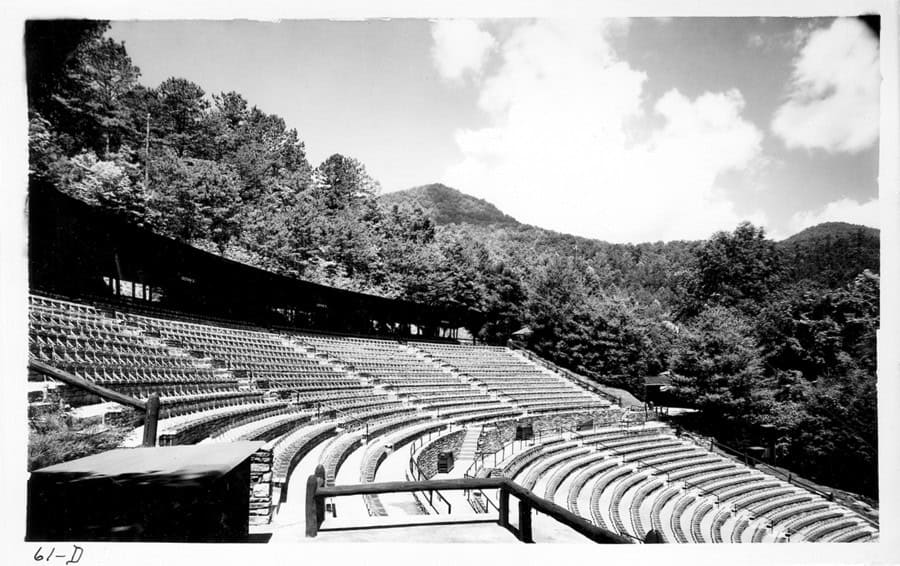
An outdoor theater must satisfy multiple — and often competing — demands.
It must have lights, sound equipment and other technology so patrons can see and hear a high-quality production. It needs seating, concession stands and restrooms to take care of visitors’ needs. It must be accessible to all visitors and bring in enough revenue to pay for everything. And it must combine all of these disparate elements without degrading the natural experience that draws patrons in the first place.
But as a CAES landscape architecture professor notes in his book on historic outdoor theaters, renovations — even small ones — can have a large impact on the open-air experience. What’s often compromised to enhance production values, convenience and revenue is the outdoor experience that’s defined by the landscape — the very thing that attracts visitors and makes a performance that much more memorable.
“When renovating outdoor theaters, you have to keep in mind the reason why people come to them as you make every design decision,” said Steve Rasmussen Cancian, an assistant professor of landscape architecture, part of the Dept. of Natural Resources and Environmental Design. “That’s why we suggest a process. If the landscape is fighting the financial imperative or the dramatic arts imperative, it’s going to lose. In the book, we propose win-win options that will preserve the landscape and deliver the other things people want.”
Cancian joined the Department of Natural Resources and Environmental Design faculty in 2020 after a career journey that connected him to North Carolina and to N.C. A&T.
Cancian managed the 1988 New Hampshire presidential primary campaign of the Rev. Jesse Jackson, one of A&T’s best-known alumni, and later worked as a community organizer in California. Cancian earned his Master of Landscape Architecture in 2003 from the University of California, Berkeley. That’s the same institution attended by Charles Fountain, Ph.D., who established at N.C. A&T the nation’s first accredited landscape architecture program at a historically Black college or university.
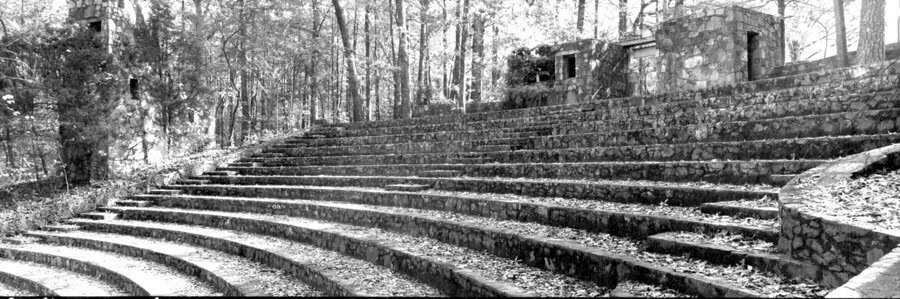
Forest Theater on the campus of UNC-Chapel Hill was originally built in 1913, and renovated most recently in 1996, where stone seats merge with topography and trees.
At UC Berkeley, Cancian was taught by Walter Hood, who was in the first graduating class of A&T’s landscape architecture program. Cancian’s mentor was Linda Jewell, a North Carolina native who received her architecture degree from N.C. State University. After earning his MLA in 2003, Cancian ran his own landscape architecture firm in California and taught at UC Berkeley and California State Polytechnic University, Pomona.
In 2018, he and Jewell, now a professor emerita, began working on a book about outdoor theater renovations. (The third co-author, Camille Thoma-Fill, was a UC Berkeley MLA student when the project began and provided graphic design and research assistance.) Cancian and Jewell conducted field research at six iconic theaters, interviewed more than 40 people associated with each venue and scoured archives for photos and documents about each site.
The result was “Preserving Landscape Experience in Historic Outdoor Theaters.” The 139-page book was supported with a $25,000 grant from and published in October 2022 by the National Center for Preservation Technology and Training, which is part of the National Park Service.
The book is a rigorous examination of six open-air theaters that successfully preserved the natural landscape experience after major renovations. It documents the landscape experience of each theater when it was built and after significant alterations. It offers best practices for renovations that consider seating; stage structures, lighting and sound; restrooms, concessions and auxiliary structures; and modern building and accessibility codes. The book concludes with a detailed process for prioritizing the landscape experience during renovations while meeting modern expectations for production values, audience comfort and revenue.
“People are drawn to these theaters because they want to experience art outdoors. Modern amenities can diminish that experience,” Cancian said. “As we explain in the book, the way to resolve that is by testing any proposed change against how it will impact a positive outdoor theater experience.”
The book already is having an impact. Cancian said another landscape architect has told him that the book influenced his choice of new seating for a theater renovation project in Washington, D.C.
Cancian said the book underscores the idea that professionals in his field are not just artists but architects who, when designing new projects and renovating existing venues, must account for people’s needs and desires.
“The landscape architect is the voice of the outdoor experience,” Cancian said. “By laying out a process that allows people — including the landscape architect — to come together, we can figure out how to fulfill everyone’s needs while preserving that experience.
Photo credit to “Preserving Landscape Experience in Historic Outdoor Theaters,” by Steve Cancian, Linda Jewell and Camille Thoma-Fill
Download the Book
Download a PDF version of Preserving Landscape Experience in Historic Outdoor Theaters.”