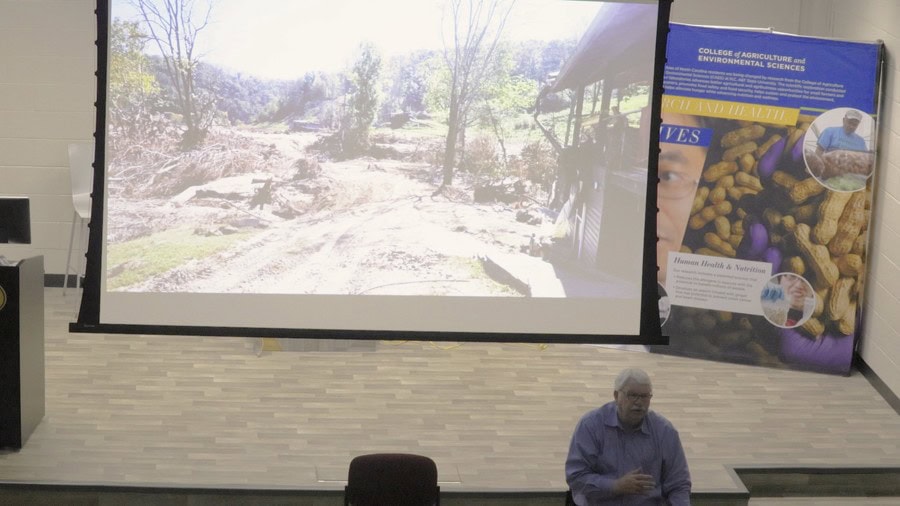
N.C. Agriculture Commissioner Steve Troxler addressed the impact of, and state response to, Hurricane Helene following its landfall in late September during a recent visit to the College of Agriculture and Environmental Sciences.
In the second of a four-part series of professional development seminars, Troxler discussed Helene’s impact on the western portion of the state – including areas such as Chimney Rock, Burnsville, Boone, Asheville, and other mountainous cities and towns – as well as the response by both the N.C. Department of Agriculture and local outreach groups to aid in recovery efforts.
“I think when this is all said in done, this will be the worst natural disaster that the state of North Carolina has ever seen by a long way,” said Troxler. “Not only in monetary terms, but in the loss of life…the problem is there was so much water in such remote places, that a lot of these people that are missing may never be found. It’s heartbreaking.”
According to the North Carolina Department of Health and Human Services, there have been 97 confirmed storm-related deaths as a result of Helene, a number that may change based on investigation.
Troxler showed images of Helene’s impact across western N.C., including heightened creeks and riverbeds, downed trees, broken asphalt in major North Carolina highways, and Department of Transportation teams on the scene moving debris and controlling traffic. Helene impacted agriculture and food distribution across the state also, he said.
“All of the food that used to be in Western North Carolina in grocery stores, even the feeding banks and their warehouses, is gone,” said Troxler. “All of that has to be restocked. That’s one of the things that we do in the Department of Agriculture. We have 38 refrigerated tractor trailers and two refrigerated warehouses, so now we’re running food to the feeding institutions in Western North Carolina, including Baptists on Mission and Samaritans First.
"A lot of cattle were washed away, we’ve had dairy farmers lose their barns and all of their structures. But through the generosity of people in and out of the state, we have collected supplies to help farmers feed their cattle through the winter. We’ve had to round up a lot of cattle, and we have high mortality rates of livestock all over the mountains. So, it’s going to be tough.”
The department must consider “what’s next” after the disaster response and food distribution effort, Troxler said.
“There has got to be a big disaster relief program for farmers and agricultural people in this state so that they can be able to farm next year,” he said.
The commissioner encouraged the students to donate as they could to community organizations, ministries and natural relief funds.
He also paid tribute to Western N.C.’s resourcefulness.
“Mountain people are as tough as anybody you’ve ever seen, and they have to be: they live in a lot of isolation, they don’t have a lot of things that people in the city have, and when they put their mind to something, they’re good to getting it done,” said Troxler. “If there’s any place in the state that could survive this, it’s them.”
N.C. A&T Cooperative Extension Responds to Hurricane Helene
Hurricane Helene cut a devastating swath across Western North Carolina and through the state’s $111 billion agricultural economy.