When North Carolina Senate Leader Phil Berger wanted to learn more about the way technology is impacting the state’s top economic endeavor, agriculture, he knew where to come: to the College of Agriculture and Environmental Sciences at N.C. A&T.
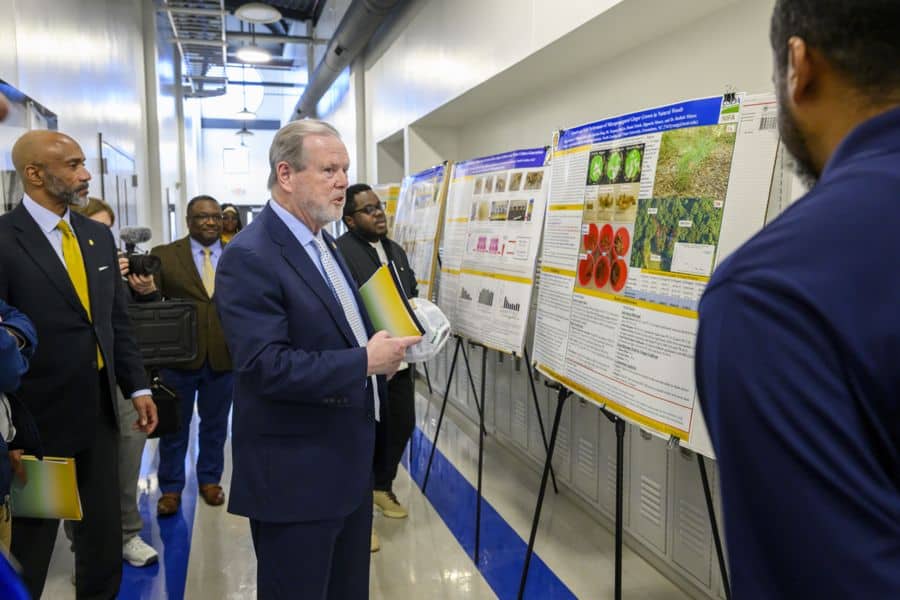
Berger, the N.C. Senate’s president pro tempore, visited the University Farm on March 3 to learn about the ways the college, and Cooperative Extension at N.C. A&T, are using technology to improve crop and animal production and train growers in its use.
Berger listened to presentations from research assistant professor Harmandeep Sharma, Ph.D., whose drone laboratory uses digital analytics to improve plant health; and from Greg Goins, Ph.D., the college’s associate dean for research, who highlighted the Department of Animal Sciences’ Automated Milking System. Using robotics, the college’s 45-cow Jersey herd can be milked voluntarily, increasing milk production and animal comfort.
“A&T is paving the way for an incredible farming future in North Carolina,” Berger said. “From its cutting-edge research and technology to deliver real-time crop health data, to being the only HBCU with a dairy program, A&T continues to achieve nothing short of excellence in both the field and the classroom. I am proud to have such an impressive university right here in North Carolina.”
The visit came in part as a nod to the college’s partnership with data analytics giant SAS Institute, headquartered in Raleigh. Using a $1 million allocation from the N.C. General Assembly from 2024, SAS brought its SAS Viya® data and AI platform to both N.C. A&T and N.C. State universities to advance agricultural research at the state’s two land-grant universities and tailor the platform for each one’s use.
“That energy is well spent,” said Shirley Hymon-Parker, interim dean of the college. “Return on investment for agricultural research and Extension outreach is $20 for every public dollar invested, according to the U.S. Department of Agriculture. With a $45 million research portfolio, the college is pulling its weight.”
"Sen. Berger understands the importance of N.C. A&T's advances in bringing 21st Century agriculture to one of North Carolina's top economic engines, agriculture, and appreciates the major contributions A&T makes to a well-educated agricultural industry workforce," said Chancellor James R. Martin II, who also joined the presentation. "We are deeply appreciative of the senator's interest in agricultural technology and education and look forward to continued conversations."
Sharma, agribusiness professor Kenrett Jefferson-Moore and three other professors in the college are conducting research and training students and farmers to use the platform, which can integrate data from many different sources, manage it and present it in various forms.
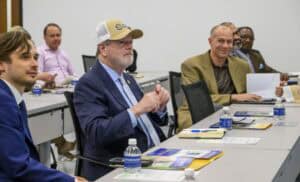
Berger shows Aggie Pride as he listens to presentations about the use of robotics and drones in the college’s research.
“This is the farm of the future,” Goins told the senator. “With urbanization in North Carolina comes competition for land. If farms cannot grow acreage-wise, they must be more efficient and reduce waste and costs, while attracting younger farmers who want a better work-life balance.
“The SAS tool gives famers and researchers alike more insight to make cost-saving decisions and solve problems, whether in the lab or on the field.”
John Gottula, Ph.D., SAS’s principal advisor for AI and biostatistics, praised A&T’s fast implementation of the platform and his students’ initiative. Gottula is adjunct faculty in the college.
“Students have jumped at the chance to use this sophisticated platform, and I find the students here to be the hungriest, most interested that I’ve ever worked with,” Gottula said. “It’s not easy to install and launch a cloud-based platform, but A&T started workshops right away with students, professors, post-docs, and of the many projects submitted, 10 projects rose to the fore, and we’re working with five of them.”
Berger and his team left the farm impressed.
“I appreciate all the information,” he said. “From drones to the Automated Milking System to specialty crops, you’re talking about ag in the 21st century.”