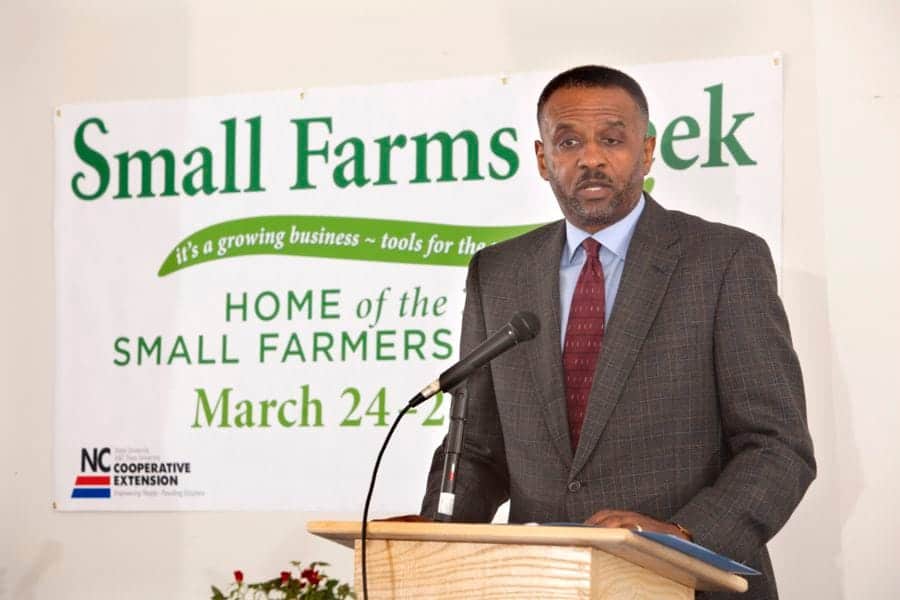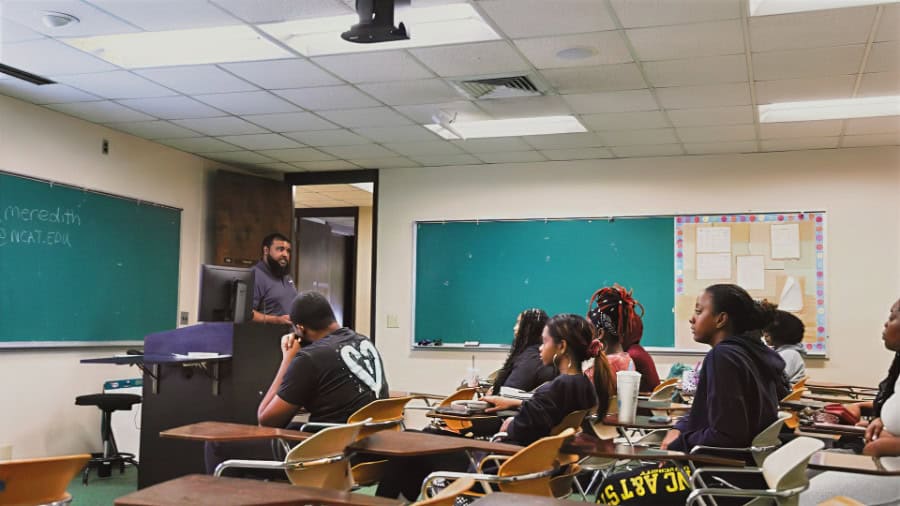

Friendly, but impassioned, debate on pros and cons of various issues in agriculture engaged students in Ag Chat sessions, held during this year’s Small Farms Week.
About 40 students gathered on March 25 at back-to-back Animal Science Ag Chats, discussing issues surrounding lab-grown, or “cultured” meat, which involves taking animal tissue samples and cultivating the cells to produce meat.
One session was co-led by Alex Meredith, Ph.D., managing director of the Agriculture Business Innovation Center, and Karla Branch, a senior studying animal science, research scholar and the corresponding secretary for N.C. A&T’s collegiate Young Farmers and Ranchers chapter. Branch said she sees social media influencers touting natural and organic foods, which could lead more affluent people to choose foods such as grass-fed beef over a more sustainable option.
“I can see some really strong pushback, with the foods you eat being politicized,” she said. “What's interesting is that younger generations, like millennials and Gen Zers, are more open to consuming lab-grown, cell-cultured or insect alternative proteins.”
She noted that within the United States, the Food and Drug Administration and U.S. Department of Agriculture have approved the sale of cell-grown chicken from “food technology” companies like UPSIDE Foods and GOOD Meat, confirming that their products meet safety standards for human consumption.
“It does look like that is the way that the tides are shifting, and it is something that as animal scientists, we could potentially be competing with or move forward behind the scenes,” she said.
Cell-culture meat has potential to reduce greenhouse gas emissions as well, if produced using renewable energy, she noted. Traditional livestock contributes to 14.5 percent of global greenhouse gas emissions.
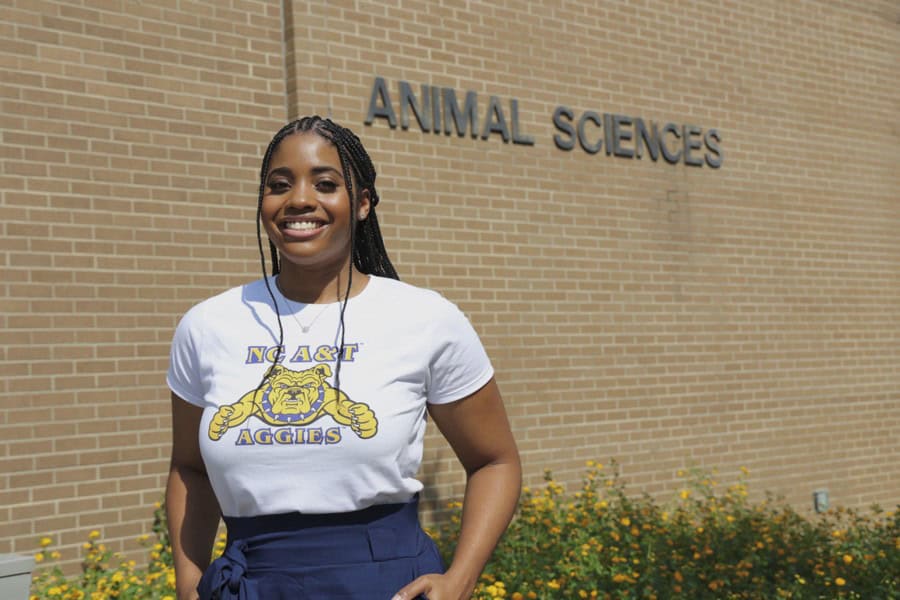
Tiyanna Anthony, an animal sciences major and Undergraduate Research Scholar, said both types of meats have pros and cons. “It takes land and energy for you to raise livestock, but it also is expensive to have all this lab equipment,” she said.
She also questioned the amount of time it's going to take to grow meat: “How fast is this meat going to grow to replace a whole cow?”
Madison Petersen, an animal sciences major and Undergraduate Research Scholar, noted the harm cultured meat could pose to rural economies.
“If people really do come around to cultured meat, … then that will take away business from these rural communities and traditional farmers who rely on their consumers to purchase from them,” she said. “If you do one thing, someone else suffers, if you do the other, somebody else suffers. There’s no 100% solution, yet.”
Radiah Minor, Ph.D., professor and chair of the animal sciences department, sees pros and cons as well.
“They'll need all kinds of chemicals,” Minor said. “You don't want bacteria to grow in there, or you’ve got to empty it out, so there'll be antibiotics potentially in there. Where does that waste go and how does it impact the environment?”
On the other hand, she said, because fewer animals would be needed, they may get more room in the yard or pen.
“Maybe they're outdoors more often, where there's more space. Or if they're indoors, there’s still more space,” Minor said.
Animal science student Anisa Scott said that she appreciated the event for the “chance to engage with the conversation.”
“Group discussions like this will definitely impact the future,” said Scott. “Especially with all of us rising to be those future-makers and potentially changing the world, so it’s important for us to work as a group and hear everybody out and how they feel on different topics.”