A hurricane, foodborne pathogens, an outbreak of global disease — all of these things by themselves could wreak havoc on the nation’s food supply. But what if several of these potentially catastrophe events happened at the same time?
CAES professor Chyi Lyi (Kathleen) Liang, Ph.D., is now working with researchers at Michigan State University and other organizations on a $10 million grant-funded project to determine how multiple simultaneous shocks could damage local and regional food systems — and how to make those food systems more resilient to ensure the nation’s food and nutritional security.
The five-year project is being funded through the Sustainable Agricultural Systems program of the U.S. Department of Agriculture’s National Institute of Food and Agriculture. North Carolina A&T State University’s portion of the grant comes to $737,485 for five years.
“Look at what COVID-19 did to us,” said Liang, the W.K. Kellogg Distinguished Professor of Sustainable Agriculture in the Department of Agribusiness, Applied Economics and Agriscience Education. “The traditional food connections from one place to another really didn’t work. When we had to shut down the economy to protect people, we shut down the food system all at once.”
That meant farmers couldn’t get their milk, meat and crops to processors and packagers, many of which had to close because their workers got sick. Trucks weren’t on the road, which meant stores ran out of food. The situation was even more dire in limited resource communities, which before the pandemic had been struggling with food security and nutrition scarcity. COVID-19, Liang added, “became a nightmare” for the national food system.
Researchers will probe existing food systems for weaknesses and examine historic data to predict the interrelated and potentially cascading effects of shocks on the nation’s food supply and supply chains, especially among underserved populations. Researchers will devise responses and mitigation strategies that account for food access, food equity, nutrition security and agricultural productivity. They also will develop outreach and extension materials to educate K-12 and postsecondary students, lawmakers and policy makers, businesses, the agricultural community, food consumers and other key stakeholders.
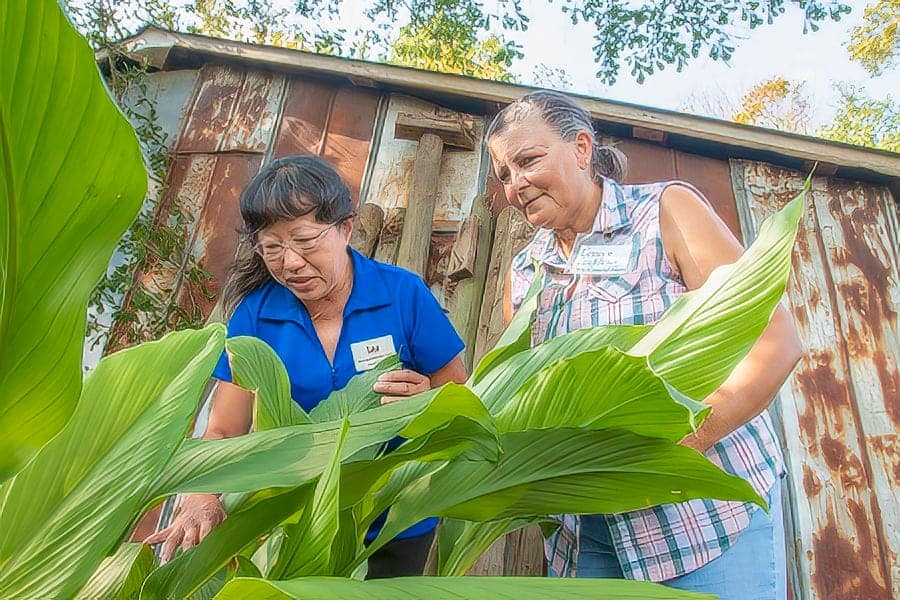
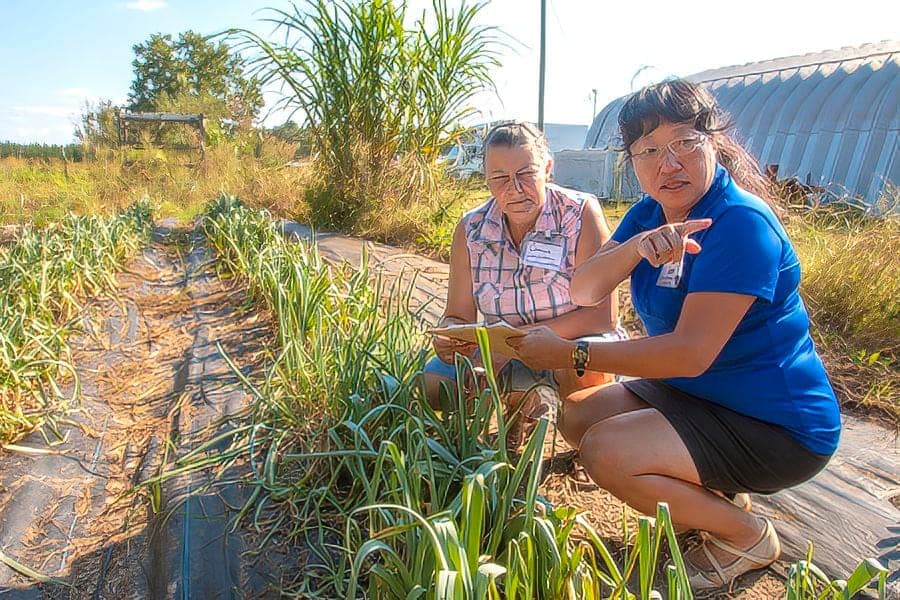
Chyi Lyi Liang, Ph.D. (left), and Connie Locklear confer during Liang's visit to Locklear's farm.
Liang will develop computer simulation models that incorporate artificial intelligence to forecast the potential integrated social, economic and environmental effects of multiple concurrent shocks and determine ways to avoid them.
An agricultural economist by training, Liang brings to the project nearly 40 years of experience and research expertise into integrated market and consumer behavior.
Liang has studied agricultural production, human eating habits and dietary needs and waste generated throughout food systems. She has developed a theoretical framework — which she will apply to this project — to reenvision effective food systems. She wrote about this interdisciplinary framework in a chapter of the latest edition of the Handbook of Agricultural Economics.
Liang also serves as co-director of the Center for Environmental Farming Systems, a nationally recognized leader in promoting just and equitable food systems and creating food system resiliency.
The project is entitled “Building Resilience to Shocks and Disruptions: Creating Sustainable and Equitable Local and Regional Food Systems in the U.S. Midwest Region and Beyond.” The principal investigator is Brent Ross, Ph.D., an associate professor in the Department of Agricultural, Food and Resource Economics at Michigan State. Liang is one of multiple co-principal investigators on the project. Other co-PIs are affiliated with Indiana University, Purdue University, the University of Illinois at Urbana-Champaign, the USDA’s Midwest Climate Hub and other public- and private-sector and nonprofit organizations.
The project will focus initially on modeling the effects of disruptions on food systems in the Midwest, but Liang said the research team plans to expand its work to the Southeast and other parts of the country.
“The outcomes of this project will be generalized into other regions,” Liang said. “Right now, we really don’t have a good grasp on how to handle this issue. This project is a first step toward figuring out how we can make this work, and we need to establish the model first.”