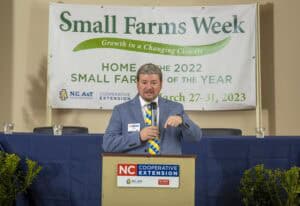
Robeson County Extension Director Mac Malloy welcomes attendees to the kickoff event.
Warmer nights, farmland loss and changing consumer habits all add up to create a challenging environment for farmers now and for consumers in the near future, a panel of farmers and farm-service providers told the audience at the kickoff event for Cooperative Extension at A&T’s 37th Small Farms Week.
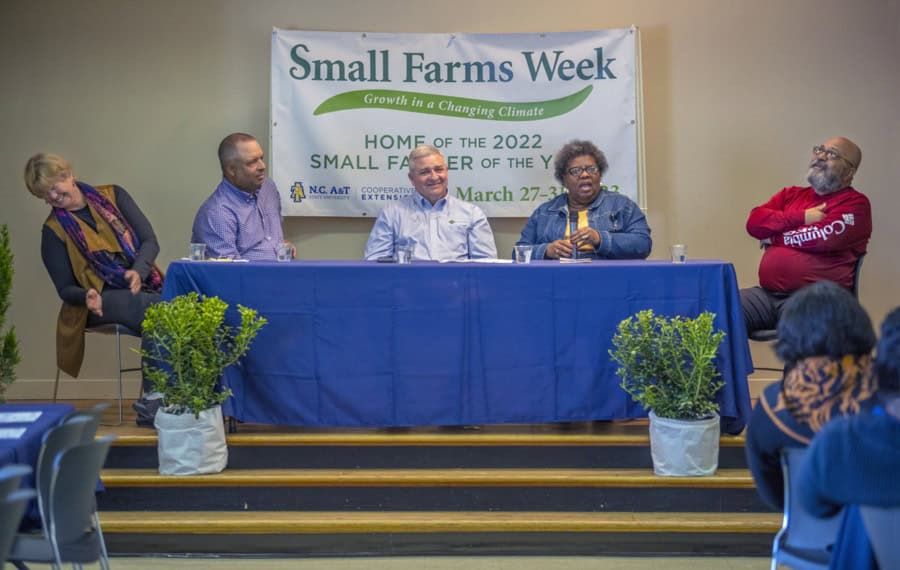
Held in Robeson County, home of 2022 Small Farmers of the Year Connie and Millard Locklear, the panel discussion centered around the theme “Growth in a Changing Climate” and brought together Kevin Kinlaw of Cape Fear Farm Credit; Robeson County farmer Ellery Locklear, who is Extension at A&T’s 2003 Small Farmer of the Year; Debbie Hamrick of the N.C. Farm Bureau Federation; Denita Council, of the Robeson County Farm Service Agency; and Millard Locklear of New Ground Farms.
Moderated by Robeson County Extension agent Nelson Brownlee, the panelists took turns discussing the ways that farms and food systems are being impacted by changes in climate; the mitigation measures they’ve used; and what steps can be taken to encourage the public to better understand agriculture.
“The big change is the climate,” said Ellery Locklear. “We’ve lost more crops in the last two years than in all the years combined since the 1950s. I’ve never had collards “bolt” (produce flowers instead of leaves) until the past two years, because it’s so warm in February. The weather’s a constant battle.”
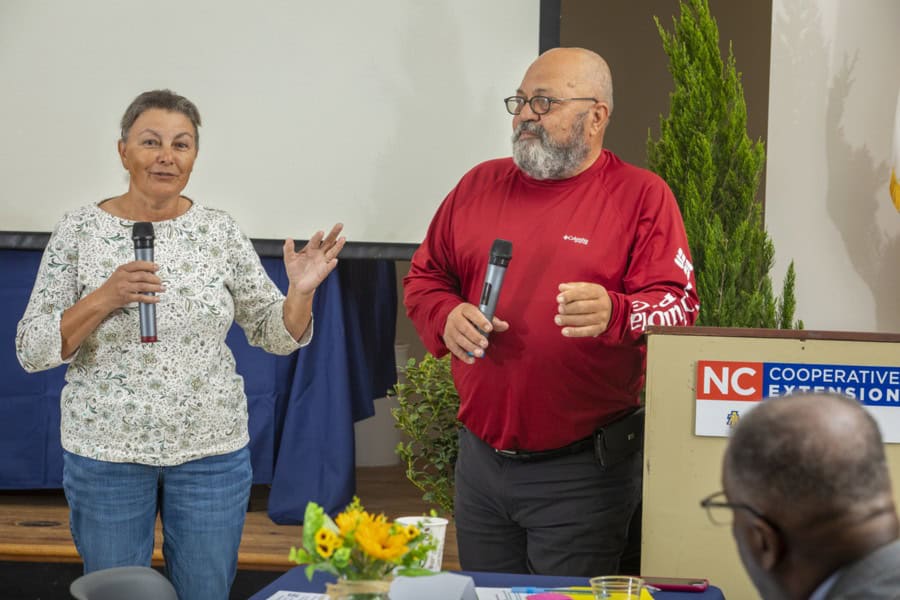
Connie and Millard Locklear describe their year as 2022 Small Farmers of the Year at the Robeson County kickoff event.
Changing weather is challenging weather that will need strategies to manage, said Hamrick.
“The characterization of our storms is different,” she said. “The clouds are holding more water because it’s hotter, so we’re not getting rain across a big area like we used to, it’s concentrating in one place and right next door, it’s dry. If a farmer’s growing crops that require ‘chilling hours,’ like blueberries – in the last years, we haven’t gotten them. Now, we have hot nights, not just warm nights, and those nights are spread out over several months, not just the dog days of summer.
“Hoop houses, greenhouses, cover crops and irrigation all help One thing won’t solve everybody’s problem. We’ve got to have multiple ways.”
North Carolina’s growing economy also brings challenges, as farmland becomes land for housing or business.
“We’ve got to get back to agricultural education in school to tell people what to do with their land,” said Council. “Our farms are deteriorating because of absentee landowners and people who don’t know its agricultural worth, so they sell it and put up a building and then go home and grow one strawberry plant in a box.
“We need to start back in middle school to revitalize the agriculture programs so people know where their food comes from.”
Eating seasonally is also a solution, said Kinlaw.
“We’re a ‘want it now’ culture,” he said. “If I want strawberries Feb. 1, I order them on Amazon and get them. People are so used to things being there when they want them that when there's a weather event like Hurricane Matthew, and the roads are shut down for days, or hot, dry days when things don’t grow, people don’t have a local food source and they just get hungrier and hungrier.
“I don’t want to see other countries supply everything we eat – we've got to figure out how to fix our food system. Our food systems are broken.”
Much of the solution starts with better agricultural education, the panel agreed.
“Students are becoming interested in agriculture again,” Kinlaw said. “Many people have six chickens, one or two tomato plants – take some students to see them. I love to see the small places, young farmers, niche markets popping up all over Eastern North Carolina, wanting money for equipment or to build a high tunnel. Farmers have got to have a supportive community.”
Eating seasonally, buying locally and narrowing the supply chain down to a local area are all part of the solution, Millard Locklear said.
“Encourage ag literacy programs, STEM literacy. Not all agriculture is farming – there's the business side, the marketing side. Agriculture skills are life skills. It’s time that we got back to them.”