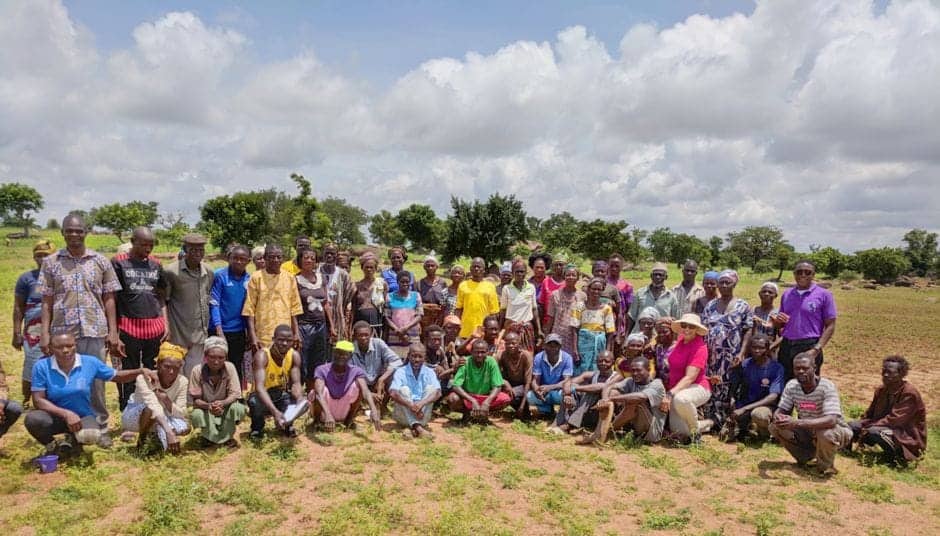
Osei Yeboah, Ph.D., standing at right in purple, and Shirley Hymon-Parker, Ph.D., kneeling at right in pink, traveled to Ghana this summer to work with farmers in the Kunkua community in the Upper East Region of Ghana, one of the country’s poorest areas.
Soybean farmers in the Kunkua community in Upper East Region of Ghana are benefitting from an organic gardening technique introduced this summer by researchers from the Savanna Agricultural Research Institute (SARI) of the Council for Scientific and Industrial Research, in conjunction with N.C. A&T.
Agribusiness professor Osei Yeboah, Ph.D., and Associate Dean Shirley Hymon-Parker, Ph.D., were among the researchers working with farmers at experimental farms in Kunkua to explain the need to adopt a procedure called rhizobium inoculation. Rhizobia are a type of soil bacteria that can transform – or “fix” – atmospheric nitrogen found in soil air spaces, after becoming established inside the root nodules of legumes, including soybeans, which helps fertilize the plants. The procedure was introduced by the researchers through Yeboahs’s 2017-19 USDA-FAS Feed the Future Food Security Project, which focuses on the country.
The inoculants are easy to apply and cheaper than traditional chemical fertilizers. In tests so far, inoculated plants outperform those that aren’t.
The three northern regions of Ghana have been described as some of the most poverty stricken regions in the country, with more than 680,000 people considered either severely or moderately food insecure.
Soybeans (glycine max) is a local crop of choice because of the plants’ ability to be cultivated in marginal soil and adverse climates, and because of their high protein content. Soybeans also hold significant economic potential for the rural farmers, since they can be sold in larger quantities to oil manufacturing firms.
However, yields on farmers’ fields are relatively low due to erratic rainfall, poor management practices and low levels of soil nutrients, particularly nitrogen and phosphorus. By using the biological nitrogen fixation method to boost nitrogen levels, small farmers can “fertilize” their crop in an environmentally clean way to boost yield.
A typical farm’s size for the Kunkua experiment was four plots, each measuring 22 yards by 32 yards.

Using mattocks, farmers weed around their peanut crop in Ghana. Because most of the field work is done by female farmers, the project encourages strong gender participation.
Yeboah, the project director, has been lending support to SARI for the past seven years in four concurrent Food Security funded projects. In talking to the farmers, he stresses strict rhizobium application, good soil, use of certified seed, adhering to the right planting dates and adopting proper planting density.
“If a rural farmer is to make any meaningful income, he or she cannot continue to do things the same way as 30 years ago,” Yeboah said. “There is the need to run their farms as businesses. Marketing and demanding identification to ensure good seed before production is paramount.”
Hymon-Parker said that she is pleased with the project’s progress, but that work must continue.
“The research Dr. Yeboah and his Ghanaian partners are engaged in is having a meaningful impact,” she said.
“The team is committed to working with more Ghanaians to increase their access to fresh fruit and vegetables,” she said. “We are proposing a new phase of the project through a grant from Feed the Future Innovation Lab.”
Feed the Future is the U.S. government’s global hunger and food security initiative, which seeks to address the root causes of hunger in the developing world. The Innovation Labs partner researchers at U.S. universities and those in developing countries to develop programs to improve nutrition and agricultural production, strengthen communities’ resilience to events that can lead to food insecurity, and increase the exchange of ideas between countries.