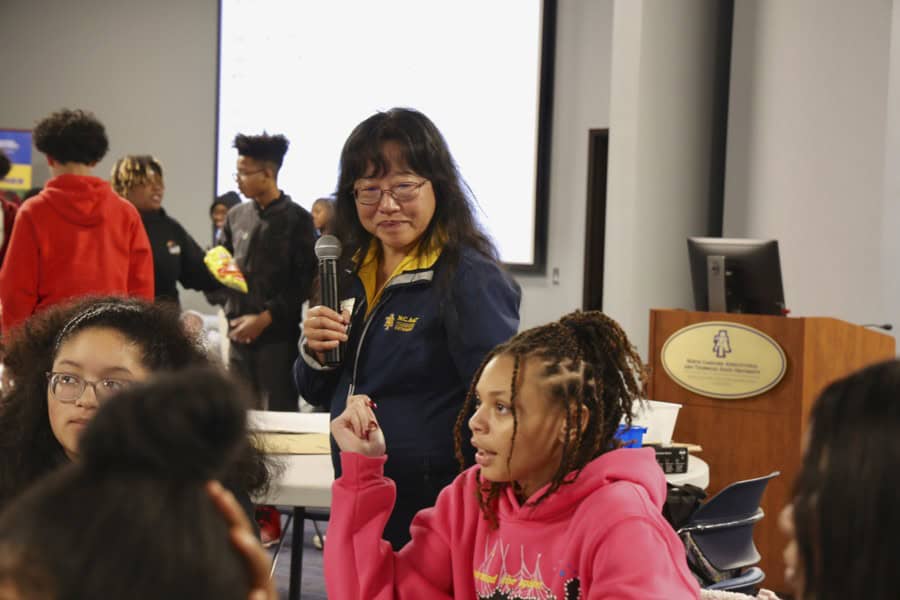
This is the fourth time Liang has received the award from the Small Business Institute.
Travelers who see a scholarly looking woman picking up Styrofoam cups that have been left behind in their hotel lobby, or digging half-empty plastic water bottles out of the trash, may be curious – but should not be alarmed.
Chances are that the person is agribusiness, applied economics and agriscience education professor Kathleen Liang, and she’s gathering the recyclable items to use as innovative teaching tools.
Nor should they worry about germs. Liang makes it a point to thoroughly wash the items in her collection before she dumps them out before an audience and asks the crowd to reimagine their possibilities.
That’s just what Liang did recently at the Small Business Institute’s national annual meeting. She dumped the recyclable trash that she’d collected during the course of her trip on the floor in front of the judges of the institute’s annual competition, and challenged them to make something new.
For her ingenuity, she received the institute’s Best Practice Award – for the fourth time.
“It’s a great way to teach about entrepreneurship, which is what I do,” she says. “Everyone else brought their PowerPoint. I showed up with a bunch of garbage.”
The exercise uses a technique called “mind mapping,” a popular behavioral science tool that helps people organize their thoughts beyond note-taking. A “mind map” is a diagram that represents a person’s thoughts about a central concept, and allows for more intuitive, non-linear thinking.
“It sorts out the thinking process and helps you make critical decisions,” Liang says. “Anyone can do it.”
In this case, Liang asked the judges and other participants to survey the pile and write down one thing that they could make from the recyclable materials, with a community charity or organization in mind that could use it, and explain their vision to the others. Then, the participants could go to the garbage, gathering the materials they needed to make their object.
One participant used a cup to make a baby rattle for a children’s hospital. Several drew on the paper, making bookmarks, paper airplanes and other toys. Another used a Styrofoam cup to make a hot or cold-item insulator for a lunchbox.
That whole process only took about 15 minutes. But Liang wasn’t finished.
“In society, one person doesn’t make one thing at a time,” Liang says. “You have to have teamwork.”
And so, each participant had to find a partner willing to combine their products to create a new, better item.
In the exercise’s final step, all participants worked together to combine all the items to make one new item that would best suit the needs of the recipient, explaining and justifying their actions as they did so. They enjoyed the exercise ... so much so that Liang won the competition.
In the entrepreneurship classes Liang teaches, the exercise helps students, who may not be prepared to participate in service learning-type agreements, to ease into working relationships and communicate effectively. The exercise is part of her award-winning Dollar Enterprise curriculum, in which teams of students create sellable items with only $1 as start-up money. Last year, the teams sent $591.44 to the Tim and Carolynn Rice Center for Child and Adolescent Health, part of the Cone Health medical group.
Since 1998, Liang says, she has conducted this exercise with more than 10,000 individuals while teaching service learning and entrepreneurship to students and non-academic audiences alike.
“Students learn to work with clients in a trustworthy, calm, comfortable manner,” Liang says. “Even better, we don’t need to rely on phones, tablets, computers – even pens or pencils – to design effective products. We only need the recycled materials around us. How cool is that?”
Travelers who see a scholarly looking woman picking up Styrofoam cups that have been left behind in their hotel lobby, or digging half-empty plastic water bottles out of the trash, may be curious – but should not be alarmed.
Chances are that the person is agribusiness, applied economics and agriscience education professor Kathleen Liang, and she’s gathering the recyclable items to use as innovative teaching tools.
Nor should they worry about germs. Liang makes it a point to thoroughly wash the items in her collection before she dumps them out before an audience and asks the crowd to reimagine their possibilities.
That’s just what Liang did recently at the Small Business Institute’s national annual meeting. She dumped the recyclable trash that she’d collected during the course of her trip on the floor in front of the judges of the institute’s annual competition, and challenged them to make something new.
For her ingenuity, she received the institute’s Best Practice Award – for the fourth time.
“It’s a great way to teach about entrepreneurship, which is what I do,” she says. “Everyone else brought their PowerPoint. I showed up with a bunch of garbage.”
The exercise uses a technique called “mind mapping,” a popular behavioral science tool that helps people organize their thoughts beyond note-taking. A “mind map” is a diagram that represents a person’s thoughts about a central concept, and allows for more intuitive, non-linear thinking.
“It sorts out the thinking process and helps you make critical decisions,” Liang says. “Anyone can do it.”
In this case, Liang asked the judges and other participants to survey the pile and write down one thing that they could make from the recyclable materials, with a community charity or organization in mind that could use it, and explain their vision to the others. Then, the participants could go to the garbage, gathering the materials they needed to make their object.
One participant used a cup to make a baby rattle for a children’s hospital. Several drew on the paper, making bookmarks, paper airplanes and other toys. Another used a Styrofoam cup to make a hot or cold-item insulator for a lunchbox.
That whole process only took about 15 minutes. But Liang wasn’t finished.
“In society, one person doesn’t make one thing at a time,” Liang says. “You have to have teamwork.”
And so, each participant had to find a partner willing to combine their products to create a new, better item.
In the exercise’s final step, all participants worked together to combine all the items to make one new item that would best suit the needs of the recipient, explaining and justifying their actions as they did so. They enjoyed the exercise ... so much so that Liang won the competition.
In the entrepreneurship classes Liang teaches, the exercise helps students, who may not be prepared to participate in service learning-type agreements, to ease into working relationships and communicate effectively. The exercise is part of her award-winning Dollar Enterprise curriculum, in which teams of students create sellable items with only $1 as start-up money. Last year, the teams sent $591.44 to the Tim and Carolynn Rice Center for Child and Adolescent Health, part of the Cone Health medical group.
Since 1998, Liang says, she has conducted this exercise with more than 10,000 individuals while teaching service learning and entrepreneurship to students and non-academic audiences alike.
“Students learn to work with clients in a trustworthy, calm, comfortable manner,” Liang says. “Even better, we don’t need to rely on phones, tablets, computers – even pens or pencils – to design effective products. We only need the recycled materials around us. How cool is that?”
Travelers who see a scholarly looking woman picking up Styrofoam cups that have been left behind in their hotel lobby, or digging half-empty plastic water bottles out of the trash, may be curious – but should not be alarmed.
Chances are that the person is agribusiness, applied economics and agriscience education professor Kathleen Liang, and she’s gathering the recyclable items to use as innovative teaching tools.
Nor should they worry about germs. Liang makes it a point to thoroughly wash the items in her collection before she dumps them out before an audience and asks the crowd to reimagine their possibilities.
That’s just what Liang did recently at the Small Business Institute’s national annual meeting. She dumped the recyclable trash that she’d collected during the course of her trip on the floor in front of the judges of the institute’s annual competition, and challenged them to make something new.
For her ingenuity, she received the institute’s Best Practice Award – for the fourth time.
“It’s a great way to teach about entrepreneurship, which is what I do,” she says. “Everyone else brought their PowerPoint. I showed up with a bunch of garbage.”
The exercise uses a technique called “mind mapping,” a popular behavioral science tool that helps people organize their thoughts beyond note-taking. A “mind map” is a diagram that represents a person’s thoughts about a central concept, and allows for more intuitive, non-linear thinking.
“It sorts out the thinking process and helps you make critical decisions,” Liang says. “Anyone can do it.”
In this case, Liang asked the judges and other participants to survey the pile and write down one thing that they could make from the recyclable materials, with a community charity or organization in mind that could use it, and explain their vision to the others. Then, the participants could go to the garbage, gathering the materials they needed to make their object.
One participant used a cup to make a baby rattle for a children’s hospital. Several drew on the paper, making bookmarks, paper airplanes and other toys. Another used a Styrofoam cup to make a hot or cold-item insulator for a lunchbox.
That whole process only took about 15 minutes. But Liang wasn’t finished.
“In society, one person doesn’t make one thing at a time,” Liang says. “You have to have teamwork.”
And so, each participant had to find a partner willing to combine their products to create a new, better item.
In the exercise’s final step, all participants worked together to combine all the items to make one new item that would best suit the needs of the recipient, explaining and justifying their actions as they did so. They enjoyed the exercise ... so much so that Liang won the competition.
In the entrepreneurship classes Liang teaches, the exercise helps students, who may not be prepared to participate in service learning-type agreements, to ease into working relationships and communicate effectively. The exercise is part of her award-winning Dollar Enterprise curriculum, in which teams of students create sellable items with only $1 as start-up money. Last year, the teams sent $591.44 to the Tim and Carolynn Rice Center for Child and Adolescent Health, part of the Cone Health medical group.
Since 1998, Liang says, she has conducted this exercise with more than 10,000 individuals while teaching service learning and entrepreneurship to students and non-academic audiences alike.
“Students learn to work with clients in a trustworthy, calm, comfortable manner,” Liang says. “Even better, we don’t need to rely on phones, tablets, computers – even pens or pencils – to design effective products. We only need the recycled materials around us. How cool is that?”
Travelers who see a scholarly looking woman picking up Styrofoam cups that have been left behind in their hotel lobby, or digging half-empty plastic water bottles out of the trash, may be curious – but should not be alarmed.
Chances are that the person is agribusiness, applied economics and agriscience education professor Kathleen Liang, and she’s gathering the recyclable items to use as innovative teaching tools.
Nor should they worry about germs. Liang makes it a point to thoroughly wash the items in her collection before she dumps them out before an audience and asks the crowd to reimagine their possibilities.
That’s just what Liang did recently at the Small Business Institute’s national annual meeting. She dumped the recyclable trash that she’d collected during the course of her trip on the floor in front of the judges of the institute’s annual competition, and challenged them to make something new.
For her ingenuity, she received the institute’s Best Practice Award – for the fourth time.
“It’s a great way to teach about entrepreneurship, which is what I do,” she says. “Everyone else brought their PowerPoint. I showed up with a bunch of garbage.”
The exercise uses a technique called “mind mapping,” a popular behavioral science tool that helps people organize their thoughts beyond note-taking. A “mind map” is a diagram that represents a person’s thoughts about a central concept, and allows for more intuitive, non-linear thinking.
“It sorts out the thinking process and helps you make critical decisions,” Liang says. “Anyone can do it.”
In this case, Liang asked the judges and other participants to survey the pile and write down one thing that they could make from the recyclable materials, with a community charity or organization in mind that could use it, and explain their vision to the others. Then, the participants could go to the garbage, gathering the materials they needed to make their object.
One participant used a cup to make a baby rattle for a children’s hospital. Several drew on the paper, making bookmarks, paper airplanes and other toys. Another used a Styrofoam cup to make a hot or cold-item insulator for a lunchbox.
That whole process only took about 15 minutes. But Liang wasn’t finished.
“In society, one person doesn’t make one thing at a time,” Liang says. “You have to have teamwork.”
And so, each participant had to find a partner willing to combine their products to create a new, better item.
In the exercise’s final step, all participants worked together to combine all the items to make one new item that would best suit the needs of the recipient, explaining and justifying their actions as they did so. They enjoyed the exercise ... so much so that Liang won the competition.
In the entrepreneurship classes Liang teaches, the exercise helps students, who may not be prepared to participate in service learning-type agreements, to ease into working relationships and communicate effectively. The exercise is part of her award-winning Dollar Enterprise curriculum, in which teams of students create sellable items with only $1 as start-up money. Last year, the teams sent $591.44 to the Tim and Carolynn Rice Center for Child and Adolescent Health, part of the Cone Health medical group.
Since 1998, Liang says, she has conducted this exercise with more than 10,000 individuals while teaching service learning and entrepreneurship to students and non-academic audiences alike.
“Students learn to work with clients in a trustworthy, calm, comfortable manner,” Liang says. “Even better, we don’t need to rely on phones, tablets, computers – even pens or pencils – to design effective products. We only need the recycled materials around us. How cool is that?”