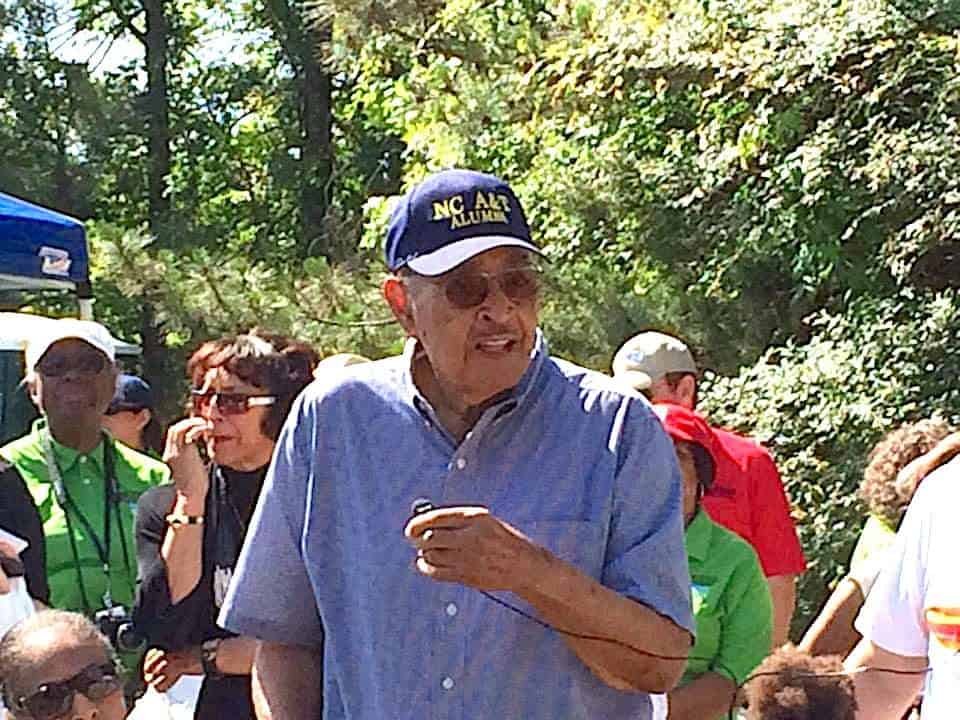
Carl Hodges Sr. ‘54, an agricultural education major, became the first Black agent in Durham County to host a regular radio program and write a weekly article in the local newspaper. In 1971, he was named the first Black county Extension director in North Carolina and the nation.
Being a trailblazer in your field often can be challenging, and for North Carolina’s Black Extension workers who started their careers during the segregation era, the challenges were many and often daunting.
For example, Carl Hodges, Sr. ‘54, was the third of 17 children born to a family in Hope Mills, N.C. in 1921. He had to travel more than 35 miles to Southern Pines for his first year of high school because there was no “Negro” high school in Cumberland County. The state soon built Armstrong High School in the county and Hodges was part of the first graduating class in 1939.
World War II interrupted his college career at North Carolina Agricultural and Technical State University, but by 1954, Hodges had earned a degree in agricultural education from N.C. A&T, had met and married Christine Hose and was the father of two young sons. He became an Extension agent in Williamston County, and moved to the Durham County Extension office in 1959, where he was the first Black agent in the county to host a regular radio program and write a weekly article in the local newspaper.
In 1971, he accomplished another first: He was named the first Black county Extension director in North Carolina and the nation. Although segregation officially ended with the Civil Rights Act of 1964, Black Extension agents had been under the direction of white administrators throughout the 1960s, and it took several attempts by state Extension administrators to gain acceptance of a Black county director. Hodges served as Durham County Extension director for 35 years, retiring in 1988. He died in 2020 at age 99.
Leaders of Covenant Presbyterian Church, where he was an active member for nearly 60 years, described Hodges as “a passionate person who has lifted up others around him. They view him as a role model.” Hodges also remained an active supporter of N.C. A&T, participating in the N.C. A&T alumni association at the state and local levels and in Omega Psi Phi, the historically African American fraternity. Hodges also served his community through the Sertoma Club, the Hayti Development Corporation, the Durham County Library Board and the N.C. Coalition for Farm and Farm Families.
Today, African Americans are well represented as county agents, county directors, specialists, and administrators in the North Carolina Extension system. N.C. A&T’s College of Agriculture and Environmental Sciences (CAES) continues to be a pipeline that brings new and diverse talent into Extension in North Carolina and across the nation.
In the 1920s, N.C. A&T offered the first short courses for Black Extension professionals because they were not allowed to attend the same courses as their white colleagues. By 1936, African American 4-H membership reached 10,000 across the state, giving youth opportunities to raise animals and crops, attend camps, and learn new agricultural techniques.
CAES is the largest agriculture and environmental sciences college among Historically Black Colleges and Universities and awards the most degrees in agricultural fields in the U.S. to Black students. Cooperative Extension at A&T remains dedicated to helping small-scale farmers, including Black and minority farmers, veteran farmers and those who live in underserved rural communities.