GREENSBORO, NC - Using plasticulture in production agriculture has been proven to increase yields and extend the growing season for small farmers.
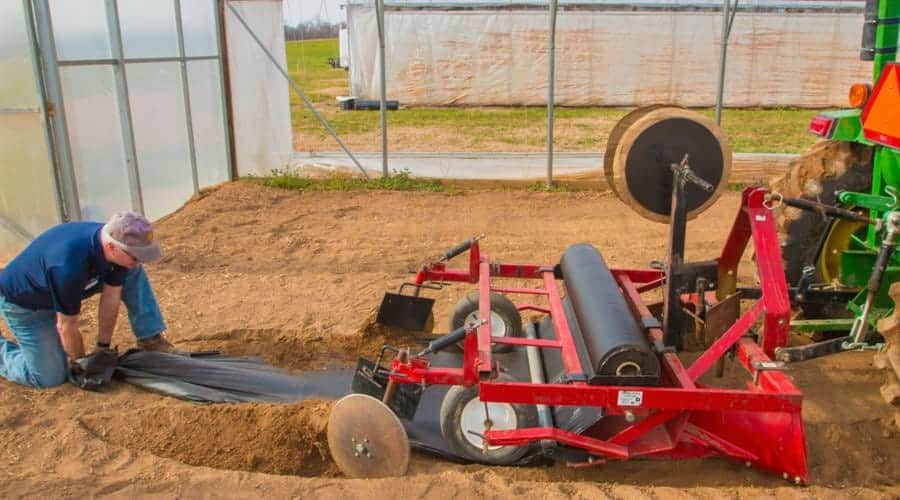
However, plasticulture equipment is expensive and beyond the reach of many small farmers. Assuming a farmer already has a tractor and the necessary equipment to prepare the site, that farmer will still need a plastic mulch layer, plastic mulch, drip irrigation tape and connectors, a tractor operator and at least one, but preferably two helpers on the ground. After the season, the farmer will need a plastic mulch lifter to remove the plastic and drape taps.
“Due to the high initial cost of purchasing plasticulture equipment, small farmers do not routinely take advantage of the benefits plasticulture production offers,” said Randy Fulk, Extension associate in horticulture production at Cooperative Extension at N.C. A&T State University.
Among those benefits are earlier harvests, better weed control, enhanced watering efficiency, and better plant nutrition by targeting nutrient applications through the drip irrigation lines. Plasticulture production also results in a cleaner crop—since no soil splashes on the crop during rains—reduces water usage, reduces disease pressure, allows for targeted nutrient applications through the drip system, and can save money on fertilizers. Plasticulture methods can also increase yields and profits for small farmers, said Fulk.
To make plasticulture production more accessible to North Carolina’s small farmers, Extension at N.C. A&T created a Plasticulture Equipment Rental/Cash Back program in 2018. The equipment is provided at county Extension centers across the state at strategic locations that give the most access to small farmers. Rental cost to the farmer is $25 a day. The savings is significant. An RB448 plastic mulch layer costs about $2,100, according to Fulk. Given the $25 a day rental cost, a farmer can save as much as $2,075 by renting compared to buying their own mulch layer. In addition to helping farmers save money, the rental program focuses on educating farmers about the value of plasticulture.
To better assist small farmers in their counties, Extension agents receive training several times a year in plasticulture equipment operation and best management practices. After renting equipment for several years and using plasticulture to increase yields and profits, farmers can use that extra savings to purchase their own equipment and become more self sufficient.
The low-cost rental program has expanded the use of plasticulture among small farmers across North Carolina. In 2020, despite operating under restrictions due to the COVID-19 pandemic, the equipment was rented by 12 individual small farmers. Of those, eight reported being first time users of the N.C. A&T plasticulture program and two reported being first time users of plasticulture as a production method. Savings for North Carolina small farmers in 2020 totaled $23,405 when compared to the cost of purchasing new equipment. Total savings for small farmers since the program began in 2018 is nearly $100,000 so far. Farmers in 14 North Carolina counties have used the equipment.
“Without this low-cost rental program, it is doubtful many small scale, limited resource farmers would be able to take advantage of the increased production plasticulture offers,” said Sanjun Gu, Ph.D., horticulture specialist with Extension at A&T. “That could erode their potential for profitability and could potentially accelerate the loss of farmland in North Carolina.”
Continuing the program during the pandemic was challenging and required developing enhanced safety plans. The university put together a task force of administrators, Extension specialists and associates, and experts from the university legal team to adopt additional guidelines that allowed the program to continue during the COVID-19 shut down. The new rules included implementing checkpoints, requiring farmers to certify they were not currently sick and had not to their knowledge been exposed to COVID-19, requiring social distancing and face masks during plasticulture operations, and mandating that all equipment be cleaned and sanitized before returning it. To further ensure the safety of all involved, Extension staff at the return locations were required to clean and sanitize the equipment once again upon return.
These additional safety precautions have allowed the plasticulture program to continue to operate during difficult times. As a result, the 12 farmers who utilized the rental program in the last year were able to expand and diversify production on farms ranging from six to 400 acres. These farmers employed plasticulture on 20 acres of production area growing a variety of crops, including vegetables, hemp, cut flowers, herbs, and berries. Without the program, it is doubtful these farmers would have taken advantage of the increased production plasticulture offers due to the high initial cost of plasticulture equipment.
“Keep in mind that these benefits and cost savings assume field production,” said Fulk. “When using plasticulture in the controlled environment of a high tunnel, all the benefits apply and many are further enhanced, including earlier harvests, greater yields, and production of a cleaner crop. In a well-managed high tunnel, disease pressure can be further offset too since no rainfall lands on crops.”