There’s more to industrial hemp than CBD oil.
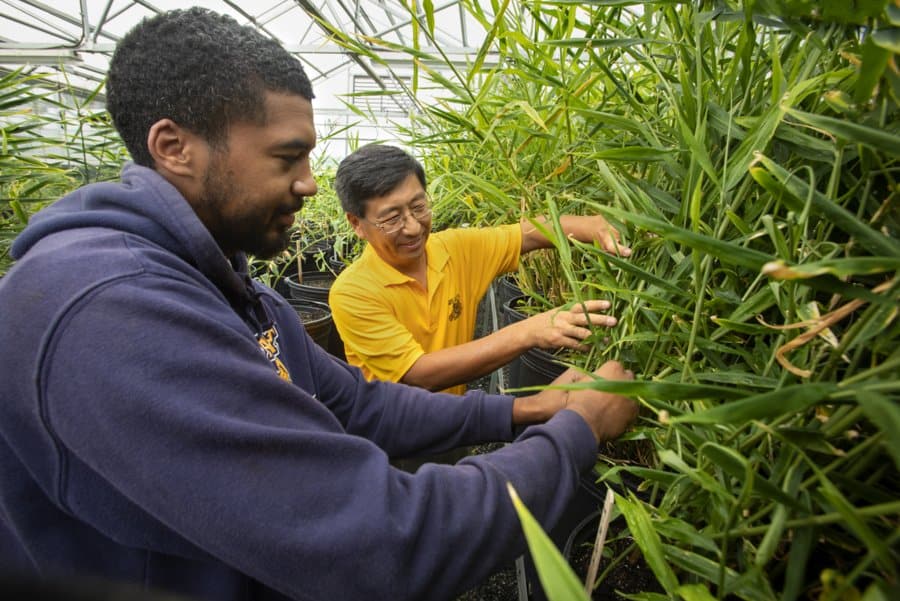
In finding ways to turn hemp into N.C.’s next high-value cash crop through sustainable, cost-effective strategies, Department of Natural Resources and Environmental Design faculty members Beatrice Dingha, Arnab Bhowmik and Louis Jackai are exploring hemp’s cultivation for grain.

Beatrice Dingha, Ph.D.
“Much of the initial interest in hemp has been focused on CBD oil, but there is much more that hemp can offer,” said Dingha, Ph.D., who is principal investigator on the project. “We currently import grain varieties from Europe and Canada. Why not grow them ourselves?”
In addition, the project will evaluate hemp’s integration into crop rotation and a technique called intercropping, or planting in close proximity with another crop to allow the farmer to grow two potentially profitable crops at once and maintain soil health.
Their research proposal was recently funded by Southern Sustainable Agriculture Research and Education (SSARE) in the amount of $229,933.
The first step in their research is to identify hemp varieties that are suitable to grow in N.C. To do this, the team plans to grow 10 to 15 grain varieties in research plots at the University Farm. Throughout the growing cycle, they will collect data on the kinds of pests and beneficial insects – predators and pollinators – that are attracted to the plants, and what their crop yield may be. They will also measure each variety’s oil and protein content.
Hemp needs nitrogen to grow, so Dingha and her team plan to intercrop hemp with cowpea cultivars that are highly attractive to pollinators. The cowpea cultivars are also very rich in nitrogen, which improves the soil.
This beneficial relationship not only provides hemp plants with nitrogen and attracts pollinators, but will give the farmers another cash crop, Dingha said.
“Hemp is a delicate crop to grow, made more difficult by the need to keep the THC level below 0.3%,” she said. “Intercropping will allow farmers to boost their profits and not rely solely on hemp. This method would also protect farmers from having to spend much money on fertilizer, which has become rather expensive.”
An additional benefit of this system is that hemp pollen and the cowpea nectar will attract pollinators thus providing benefit to pollinator-dependent crops, such as squash or watermelon that are present in the same farm or nearby farms.
Pollinators as a whole contribute $24 billion to the U.S. economy, of which honey bees contribute $15 billion, Dingha said. However, bee colonies have recently been declining. As a countermeasure, one strategy has been to increase abundance of bee forage resources on farmlands.
In the project’s first year, Dingha and her team will grow hemp varieties at the University Farm. Four farmers from around the state will be involved with the project, and make visits to the research plots to see setup of plots and monitor the crops’ progress. In the project’s second and third year, the four farmers will use knowledge gained from the first year to set up experimental plots on their own farms, choosing the best adapted hemp variety in combination with the cowpea varieties and a pollinator-dependent crop of their choice. They will also attend the Small Farms Field Day and Small Farm Week events at N.C. A&T in the second and third year of the project.
Dingha has high hopes for the project, which will now start in 2021 due to COVID-19.
“If one crop doesn’t do well, the farmer will have two others to fall back on,” she said. “We want to find a combination that benefits the environment and also increase farm profits.”