It comes down to trust, something not easily given by indigenous people who have seen more promises broken than kept.
But Beatriz Rodriguez, extension associate for Cooperative Extension at N.C. A&T, is intent on building confidence among Native Americans that tribes and Extension can collaborate to provide culturally appropriate resources and programming to enhance their communities.
“The goal is to build trust, first of all, and then to foster that climate — an environment in which we can start working together,” said Rodriquez, N.C. A&T Extension’s urban audiences coordinator.
There are eight tribes in North Carolina: Coharie, Eastern Band of Cherokee, Haliwa-Saponi, Lumbee, Meherrin, Occaneechi Band of Saponi, Sappony and Waccamaw Siouan.
Rodriguez started by reaching out last year to some of the communities, including the Triangle Native American Society, the Lumbees and the Haliwa-Saponi. She attended the Guilford Native American Association’s Pow Wow, where hundreds of Native American dancers from different tribes across the country gather at Greensboro Country Park to celebrate their history and culture.
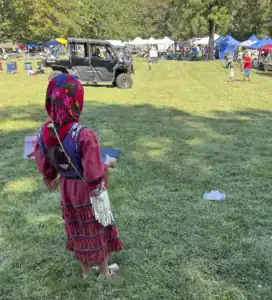
A Native American child operates a robot at the Guilford Native American Association’s Pow Wow in September.
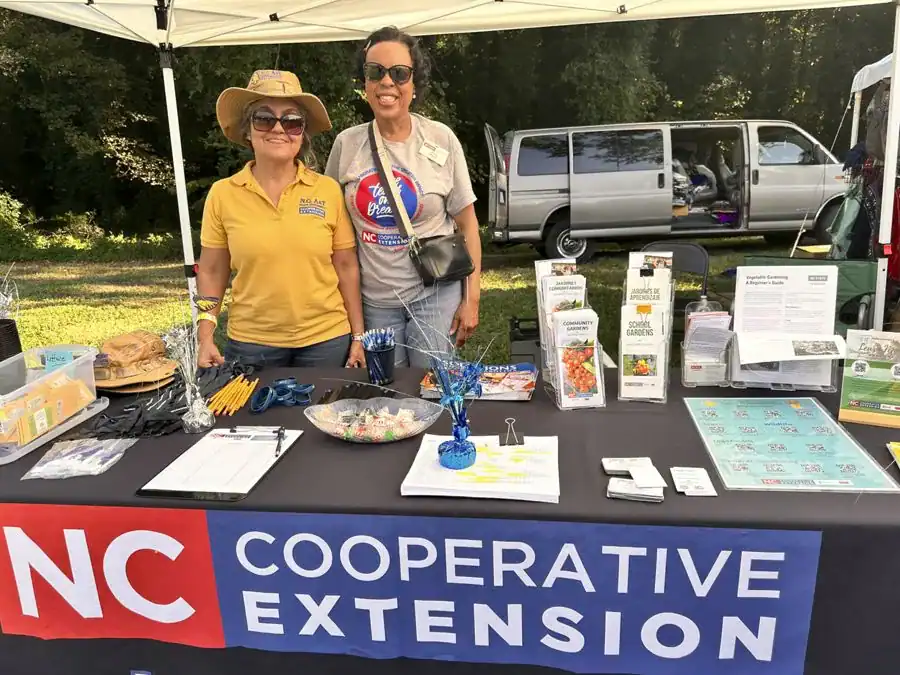
For this year’s Pow Wow in September, Rodriguez brought Extension to the event with the help of Crystal Mercer, Guilford County Cooperative Extension agent for community and school gardens; Morgan Malone, Extension’s urban agriculture and community gardens coordinator; Natalie Owens, Guilford County Extension Director; Mark Light, Ph.D., 4-H STEM (science, technology, engineering and math) specialist; and Lauren Taubert, Extension Agent, 4-H youth development.
Light brought drones and robots to the Pow Wow for participants to try out. “The kids were very engaged,” Rodriguez said.
That involvement is important, she said: “If we participate in their events, we can create that same desire to participate in our programs as well.”
One project that Extension and the Guilford Native American Association are considering working on together is a community garden.
The association would like to see youth and elders working together in community gardens, Rodriguez said. That may initially involve a small plot at the N.C. A&T University Farm and potentially expand to a larger Guilford County community garden.
“Newer generations are more disconnected from planting, growing, gardening,” she said. “It’s kind of giving them the opportunity to learn and keep their culture alive.”
She also sees it as an opportunity to uplift the efforts of both the tribes and Extension to improve lives.
“The poverty level among indigenous people is very, very high,” Rodriguez said, “so it’s not fair to me, considering that they are the first people living and working in this land.”
According to a U.S. Department of Agriculture study between 2026 and 2021, 23.3 percent of American Indian and Alaska native households were food insecure compared to 11.1 percent of all U.S. households.
Rodriguez hopes her efforts will help others understand and value the customs and traditions of Native Americans.
One example Rodriguez used is the U.S. Department of Agriculture’s MyPlate, a visual tool to help people build healthy eating habits by dividing a dinner plate into sections for different food groups.
“MyPlate for Americans may not be the same as MyPlate for indigenous people. It may vary a little bit,” Rodriguez said. “So, we need to keep in mind those little details that make things really culturally appropriate.”
She noted that Extension also has adopted practices that originated with indigenous people, such as the “Three Sisters,” a companion planting practice where corn, beans and squash are planted together in a symbiotic relationship.
Corn provides tall stalks for the beans to climb. Beans provide nitrogen to fertilize the soil while also stabilizing the tall corn during heavy winds. And the large leaves of squash plants shade the ground, helping retain soil moisture and prevent weeds.
And while A&T researchers continue exploring the connection between food and medicine, Rodrigues pointed out that Native Americans use a lot of natural remedies. “I know there’s a lot of wisdom in what they do.
“Sometimes we want to impose things,” she said, “but I think the best, smartest way is to work alongside them and not dismissing what they have been doing all these years.”